Sine
Sine of an angle in a right triangle
In a right triangle OAB OA and AB are legs, OB is hypotenuse.The sine of an angle in a right triangle is equal to the ratio of the
Designations: sin, sin α, sin x
The sine of an angle in a right triangle is equal to the ratio of the opposite leg AB to the hypotenuse OB.
Designations: sin, sin α, sin xFor example, if the opposite leg is 2 and the hypotenuse is 4, then the angle α will be equal to 30°, and sine of angle α will be 2/4=0.5
As you can see, if the angle tends to 0, then the leg AB will tend to 0 and sine of the angle in this limiting case will be equal to 0: AB/OB = 0/OB = 0.
And in the same way, if the angle tends to 90 degrees, then the length of the opposite leg will be strive to be equal to the length of the hypotenuse and sine of such an angle in the limit case will be equal to 1: AB/OB = OB/OB = 1.
Sine of an arbitrary angle
The sine of an angle in a right triangle is the sine of an acute angle, a special case of the sine of an arbitrary angle
Sine of an arbitrary angle (acute, right, obtuse, straight, concave, full) - the ordinate of a point (vertical coordinate y) obtained by rotating the point (1; 0) around the origin by an angle counterclockwise on a unit circles.
What is the relationship between the sine of an arbitrary angle and the sine in a right triangle? The radius OB, its projection OA onto the x-axis and the segment AB connecting the radius and the projection form such a right triangle . The radius is the hypotenuse, its projection OB is the adjacent side, segment AB is the opposite side. As you can see, segment AB is equal to the projection of the radius onto the y-axis. And the sine of the angle will be the ratio of the length of the segment AB to the hypotenuse. If we consider a circle with radius 1, then the hypotenuse is equal to 1 and the sine of the angle is equal to the length of the segment AB or the ordinate of a point on the circle, its coordinate along the y axis.
From this it follows that:
1. The sine values of angles from 0° to 180° are positive in the segment [0, 1]
1. The sine values of angles from 0° to 180° are positive in the segment [0, 1]
2. The sine values of angles from 180° to 360° are negative in the segment [-1, 0]
3. And, summing up, the entire range of values [-1; 1]
4. Angle values from 90° to 180° mirror the angle values from 0° to 90°
5. Angle values from 180° to 270° mirror the angle values from 270° to 360°
6. Sine axis - vertical axis, ordinate axis, y axis
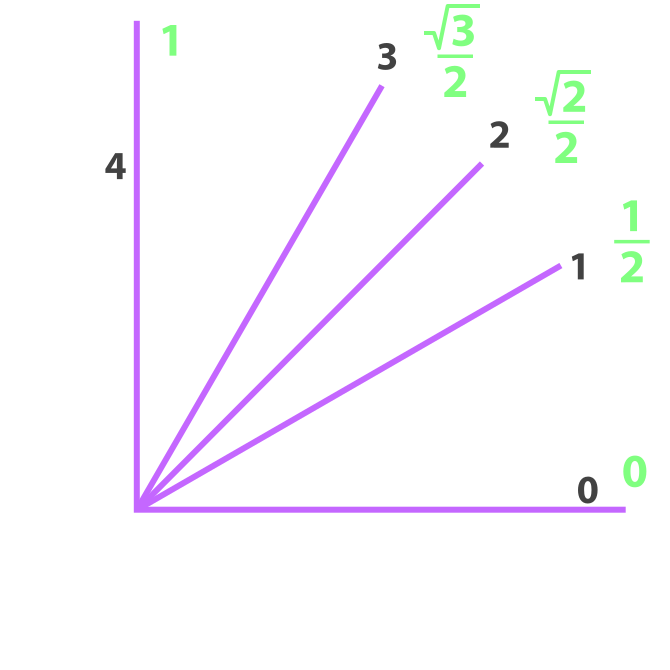
Values of the sine of some angles.
where N is the finger number starting from the little finger.
Mnemonic rule:
`sin α = sqrt(N)/2, `
| Finger number | 0 | 1 | 2 | 3 | 4 |
| Angle in degrees | 0° | 30° | 45° | 60° | 90° |
| Angle in radians | 0 | `pi/6` | `pi/4` | `pi/3` | `pi/2` |
| Value | 0 | `1/2` | `sqrt(2)/2` | `sqrt(3)/2` | 1 |
Equation
The equation sin x = a means that you need to find angles x whose sine is equal to a. For example the equation
`sin x = 1`
has solutions `x=pi/2+2pik, k∈Z`
That is, x is an infinite series of values `... -(7pi)/2, -(3pi)/2, pi/2, (5pi)/2, (9pi)/2 ...`
And the equation
`sin x = 0.5`
has solutions `x=(-1)^k*pi/6+pik, k∈Z`
That is, x is an infinite series of values `... -(11pi)/6, -(7pi)/6, pi/6, (5pi)/6, (13pi)/6, (17pi)/6 ...`
Properties
Сompare properties
Function
`y = sin x`
The sine function is inversely proportional to the cosecant function.
Function domain
`D(sin x) = R`
The domain of definition of the sine is the entire numerical axis.
Range
`E(sin x) = [-1, 1]`
The range of values of the sine is the interval from -1 to 1. This happens because the sine is the ratio of the leg to the hypotenuse, and the leg in a triangle is always less, or, in the extreme case, equal to the hypotenuse.
Parity
`odd`
When the angle value passes through 0, the sine function of this angle also changes its sign. The function is symmetrical about the coordinate center.
Periodicity
`T = 2pi`
The trajectory of the sine function begins to repeat only after completing a full circle.
Zeros
`sin x = 0, x=pin, n in Z`
The sine function has zero values at points between the I and IV quarters and between the II and III quarters of the circle
Constant sign intervals
`sin x < 0, x in (2pin, pi + 2pin), n in Z`
`sin x > 0, x in (-pi + 2pin, 2pin), n in Z`
The sine function is negative in the III and IV quarters and positive in the I and II quarters of the circle.
Monotony intervals
`uarruarruarr x in [-pi/2 + 2pin, pi/2 + 2pin], n in Z`
`darrdarrdarr x in [pi/2 + 2pin, (3pi)/2 + 2pin], n in Z`
The sine function increases in the I and IV quarters, and decreases in the II and III quarters of the circle.
Extrema
`y_min = -1, x = -pi/2+2pin, n in Z`
`y_max = 1, x = pi/2+2pin, n in Z`
The sine function has local minima equal to -1 between the III and IV quarters and local maxima equal to 1 between the I and II quarters of the circle.
Inflection points
`y=0, x = pin, n in Z`
The sine function has an inflection point between the II and III quarters and between the I and IV quarters of the circle with a value of 0.
Formulas
`sin alpha = cos(alpha - pi/2)`
`sin alpha = +- sqrt(1 - cos^2alpha)`
`sin alpha = cos alpha * text(tan α)`
`sin alpha = cos alpha / text(cot α)`
`sin alpha = - sin(-alpha)`
`(sin alpha)^' =cos alpha`
`int sin (alpha)dalpha = -cos alpha + C`
`alpha*cos alpha < sin alpha < alpha, 0< alpha< 1`