Tangent
Tangent of an angle in a right triangle
In a right triangle OAB, OA and AB are the legs, OB is the hypotenuse.The tangent of an angle in a right triangle is equal to the ratio of the
Designations: tan, tan α, tan x
The tangent of an angle in a right triangle is equal to the ratio of the opposite leg AB to the adjacent leg OA.
Designations: tan, tan α, tan xFor example, if the opposite leg is equal to 1, and the adjacent leg is also equal to 1, then the angle α will be equal to 45°, and the tangent of the angle α will be 1 / 1 = 1
As you can see, if the angle tends to 0, then the length of the opposite leg AB will tend to 0, the length of the adjacent leg OA will tend to equal the length of the hypotenuse and angle tangent in this limiting case will be equal to 0: AB/OA = 0/OA = 0.
And in the same way, if the angle tends to 90 degrees, then the length of the opposite leg AB will tend to equal the length of the hypotenuse, the length of the adjacent leg OA will tend to 0 and tangent angle in such a limiting case will tend to infinity and in the end it will not be determined: AB/OA = AB/0 = X (±∞).
Tangent of an arbitrary angle
The tangent of an angle in a right triangle is the tangent of an acute angle, a special case of the tangent of an arbitrary angle
Let us draw an additional vertical axis parallel to the ordinate axis through the point (1; 0) - the tange axis. Tangent of an arbitrary angle (acute, straight, obtuse, straight, concave, full) - ordinate of a point (vertical coordinate y) on the tangent axis 3. And, summing up, the entire range of values [-∞; ∞] obtained by rotating the point (1; 0) around the origin by an angle counterclockwise arrows on the unit circle and the continuation of the radius segment until it intersects with the tangent axis.
What is the relationship between the tangent of an arbitrary angle and the tangent in a right triangle? The tangent of an angle in a right triangle OAB is equal to the ratio of the opposite side AB to the adjacent side OA. Triangles OAB and OA'B' are similar, which means the tangent of the angle is also equal to the ratio of A'B' to OA'. OA' is the radius of the circle and is equal to 1. Therefore, the tangent of the angle is equal to A'B' or the ordinate of the intersection point of the continuation of the radius and the tangent axis.
From this it follows that:
1. The tangent values of angles from 0° to 90° and from 180° to 270° are positive in the segment [0, +∞]
1. The tangent values of angles from 0° to 90° and from 180° to 270° are positive in the segment [0, +∞]
2. The tangent values of angles from 90° to 180° and from 270° to 360° are negative in the segment [-∞, 0]
3. And, summing up, the entire range of values [-∞; ∞]
4. Values for angles between 90° and 270° are not defined
5. Angle values from -90° to 90° centrally symmetrically repeat angle values from 90° to 270°
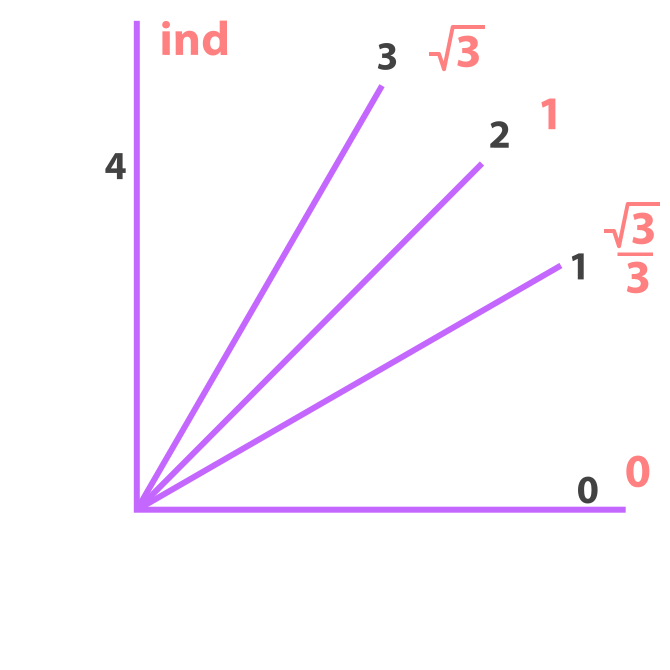
Tangent values of some angles.
where N is the finger number starting from the little finger. The exception is the thumb (90°), for which the value is not defined
Mnemonic rule:
`tan α = sqrt(3)^N/3, `
| Finger number | 0 | 1 | 2 | 3 | 4 |
| Angle in degrees | 0° | 30° | 45° | 60° | 90° |
| Angle in radians | 0 | `pi/6` | `pi/4` | `pi/3` | `pi/2` |
| Value | 0 | `sqrt(3)/3` | `1` | `sqrt(3)` | ind |
Equation
The equation tanx = a means that you need to find angles x whose tangent is equal to a. For example the equation
`tan x = 1`
has solutions `x=pi/4+pik, k∈Z`
That is, x is an infinite series of values `... -(7pi)/4, -(3pi)/4, (pi)/4, (5pi)/4, (9pi)/4, ...`
And the equation
`tan x = 0`
has solutions `x=pik, k∈Z`
That is, x is an infinite series of values `... -2pi, -pi, 0, pi, 2pi, 3pi, ...`
Properties
Сompare properties
Function
`y = tan x`
The tangent function is inversely proportional to the cotangent function.
Function domain
`D(tan x) = R - {pi/2+pin (n in Z)}`
The tangent definition area is the entire numerical axis, with the exception of points at which the adjacent leg (or cosine of the angle) is equal to zero and an uncertainty of the form 1/0 is obtained. On the circle, these are the boundaries between the I and II quarters and between the III and IV quarters.
Range
`E(tan x) = R`
Tangent range - entire numerical axis.
Parity
`odd`
When the angle value passes through 0, the tangent function of this angle also changes its sign. The function is symmetrical about the coordinate center.
Periodicity
`T = pi`
The tangent function path repeats every half circle.
Zeros
`tan x = 0, x=pin, n in Z`
The tangent function has zero values at points between the I and IV quarters and between the II and III quarters of the circle.
Constant sign intervals
`tan x > 0, x in (pin, pi/2 + pin), n in Z`
`tan x < 0, x in (-pi/2 + pin, pin), n in Z`
The tangent function is negative in the II and IV quarters and positive in the I and III quarters of the circle.
Monotony intervals
`uarruarruarr x in D`
The tangent function increases throughout its entire domain of definition. That is, it always increases.
Extrema
`no`
The tangent function has no minimums or maximums because it always increases.
Inflection points
`y=0, x = pin, n in Z`
The tangent function has inflection points between the II and III quarters and between the I and IV quarters of the circle with a value of 0.
Formulas
`tan alpha = sin alpha / cos alpha`
`tan alpha = 1/text(cot α)`
`tan alpha = - cot(alpha + pi/2) = - cot(alpha - pi/2)`
`tan alpha = sqrt(1/cos^2alpha - 1)`
`-tan alpha = tan(-alpha)`
`(tan alpha)^' =1 /cos^2 alpha`
`int tan(alpha) dalpha = -ln |cos alpha| + C`